Home / Blog / Getting around
MRT crowds in Singapore: when and where stations were busiest, 18 to 25 October
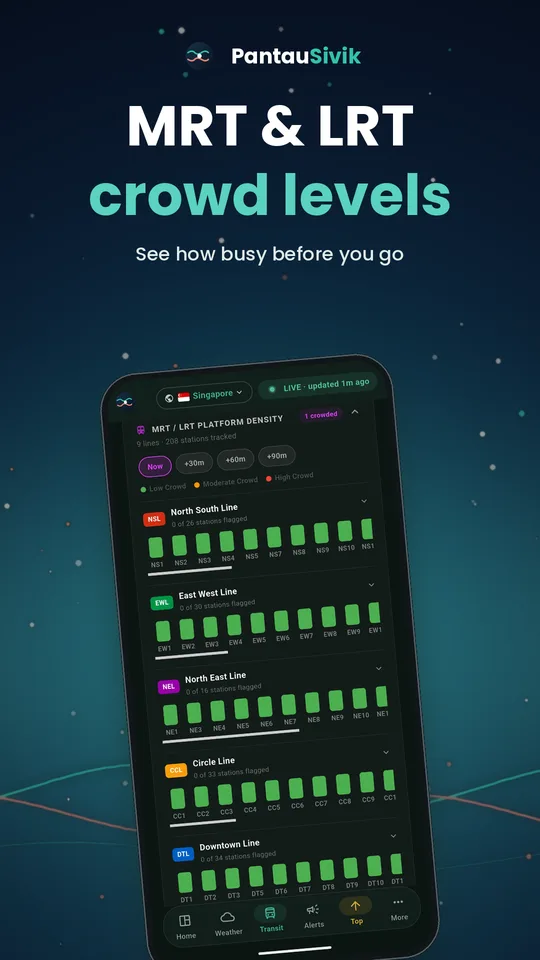
PantauSivik's crowd view shows how busy an MRT or LRT station is right now, as Low, Moderate or High, with a short forecast. We also keep a record of every change. This post looks at that record for the eight full days from Sunday 18 to Sunday 25 October 2026. Our earlier posts on checking MRT crowds before you leave and on Little India at Deepavali use the same records.
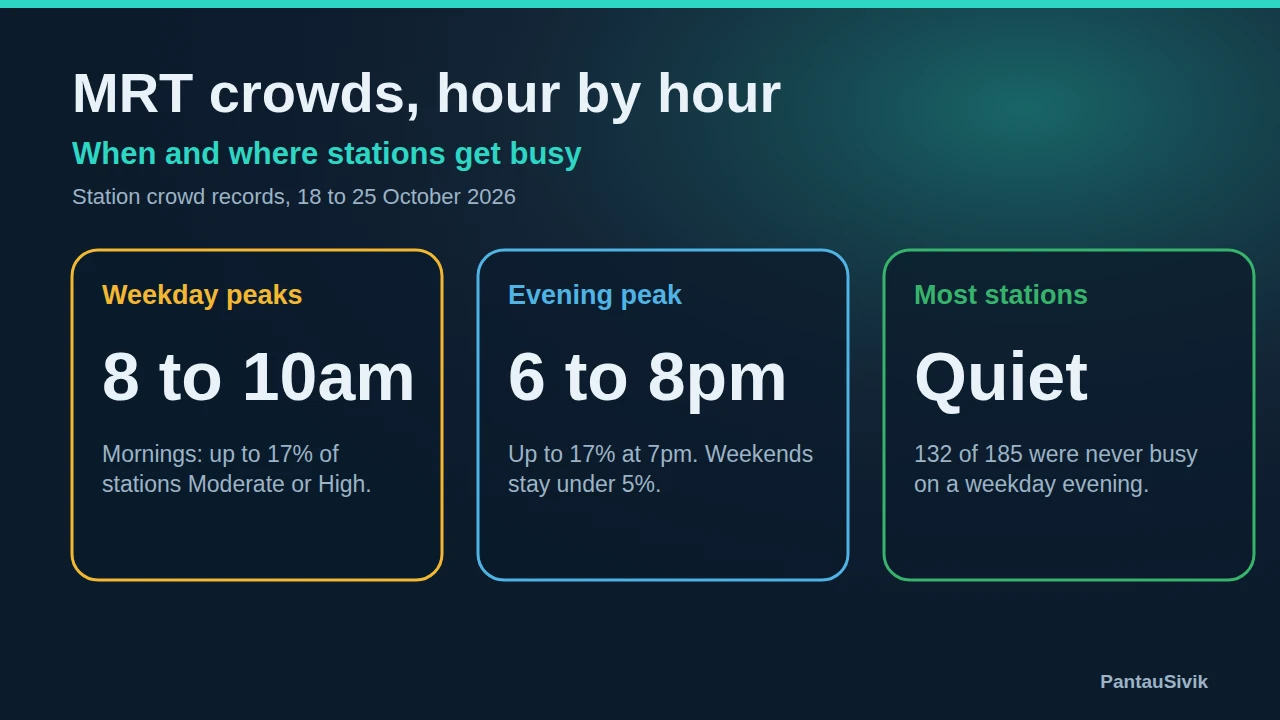
In short: on weekdays, stations were Moderate or High for 6.3% of readings from 6pm to 10pm, against 2.1% at weekends. Weekday crowding was concentrated at 8 to 10am and 6 to 8pm. Most stations, 132 of 185, were never busy on a weekday evening. A smaller group reported busy often, so the live view matters more than any average.
How we counted
A station's crowd level is logged each time it changes. We rebuilt a reading every ten minutes for each station from those changes. Most interchange stations carry the same reading under each of their line codes, so we counted each station once, which gives 185 stations. We left out seven station codes, five on the Thomson East Coast Line and two on the Downtown Line, whose level showed a single High reading at the start and never changed. They have no name in our station list and may be stations that are not yet open.
When stations get busy
The chart shows, for each hour, the share of stations that were Moderate or High.
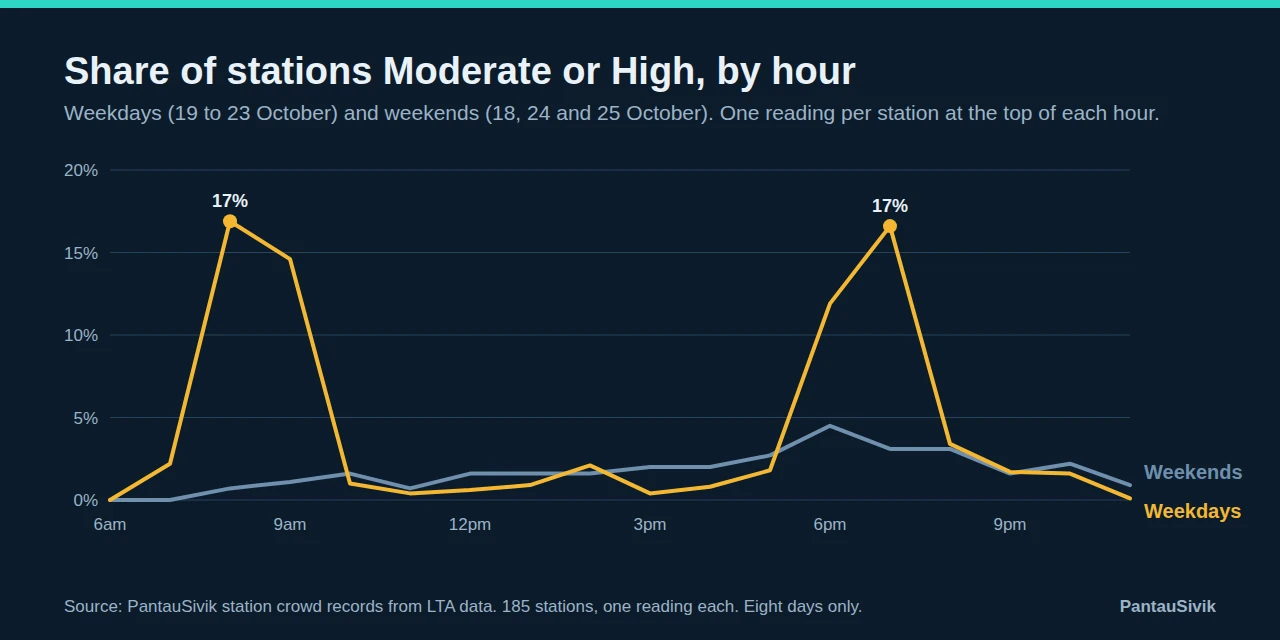
- Two sharp weekday peaks. About 17% of stations were Moderate or High at 8am and again at 7pm. By 10am the share had fallen to 1% and by 8pm to 3%.
- Midday and early afternoon were quiet. From 10am to 5pm on weekdays it stayed between 0.4% and 2.1%.
- Weekends never rose above 5%. The highest weekend reading was 4.5% at 6pm.
- Weekday evenings were busier than Sundays. Across all stations, weekday evenings from 6pm to 10pm were at 6.1% to 6.6%, Sunday evenings at about 2.4% and Saturday evenings at 1.4%.
Where stations reported busy
For each station we counted the share of ten minute readings that were Moderate or High on the five weekdays, 19 to 23 October. These are the eight stations with the highest share in each peak, and the share of readings at High.
| Weekday mornings, 7am to 10am | Moderate or High | High |
|---|---|---|
| Lakeside | 93% | 12% |
| Sembawang | 93% | 3% |
| Woodlands South | 77% | 17% |
| Serangoon | 76% | 2% |
| Bukit Panjang | 74% | 36% |
| Sengkang (MRT) | 72% | 0% |
| Tanah Merah | 69% | 0% |
| Admiralty | 68% | 13% |
| Weekday evenings, 6pm to 10pm | Moderate or High | High |
|---|---|---|
| Kent Ridge | 81% | 28% |
| Jurong East | 68% | 0% |
| Shenton Way | 56% | 29% |
| City Hall | 56% | 11% |
| Raffles Place | 50% | 4% |
| Joo Koon | 46% | 23% |
| Downtown | 46% | 14% |
| Buona Vista | 43% | 3% |
- Mornings point to the suburbs. Most of the busy morning stations are towards the ends of the lines in the north and north east, such as Sembawang, Woodlands South, Admiralty and Sengkang, plus Lakeside in the west and Tanah Merah in the east. That is where journeys start.
- Evenings point to the centre and the west. City Hall, Raffles Place, Shenton Way and Downtown are in the central business district, and Kent Ridge, Jurong East, Buona Vista and Joo Koon are in the west and south west.
- Most stations were quiet. On weekday evenings 132 of 185 stations were never Moderate or High, and 22 were busy for a fifth of the time or more. In the mornings it was 134 and 28.
- Sunday evenings were different. Averaged over the two Sundays, City Hall was Moderate or High for 71% of the evening, Orchard for 60%, and Paya Lebar and Farrer Park for 48%, even though the network as a whole was calm.
The Sengkang LRT station was Moderate or High for most of every day, which looks like how that station is reported, so we left it out of the lists.
What this does not tell you
It is eight days, so it is a pattern to check, not a rule. A level is the Land Transport Authority's estimate for the station, not a count of people and not how full the train is. An event, a train fault or the school holidays can change the picture on any day.
Using this in the app
- Open the platform crowd view and switch between Now, +30, +60 and +90 minutes. A short wait can mean a calmer station.
- Use the Trip Planner to compare routes before you leave.
- Look at Public Alerts for train faults that can push crowds up.
Common questions
When are MRT stations busiest on weekdays?
In PantauSivik records from 19 to 23 October 2026, the share of stations at Moderate or High peaked at about 17% at 8am and again at about 17% at 7pm. Outside 8 to 10am and 6 to 8pm it was mostly under 3%.
Are weekends busy?
Much less so. On 18, 24 and 25 October, the share of stations at Moderate or High stayed under 5% at every hour, and was 2.1% of readings from 6pm to 10pm, against 6.3% on weekday evenings. A few city stations were busy on Sunday evenings.
Which stations were busiest?
On weekday mornings, stations in the north and north east, such as Sembawang, Woodlands South and Sengkang, and Lakeside in the west, reported busy most often. On weekday evenings it was mostly the centre and the west, such as Kent Ridge, Jurong East, Shenton Way and City Hall.
How does PantauSivik know how crowded a station is?
It uses the Land Transport Authority's real time station crowd levels, shown as Low, Moderate or High, and updated roughly every ten minutes. The level is an estimate for the station, not a count of people.
Sources: PantauSivik station crowd records built from the Land Transport Authority's real time station crowd data, 18 to 25 October 2026. Station names from the PantauSivik station list. Figures are shares of ten minute readings, not people. Levels can differ from what you see on the day.
Information in PantauSivik comes from public sources and is there to help you plan. PantauSivik is independent and not affiliated with the Land Transport Authority, SMRT or SBS Transit.
See also: Check MRT and LRT crowds before you leave, Deepavali weekend in Little India, Are buses really crowded?, MRT platform crowds guide, Trip Planner guide, Public Alerts guide.